Skip to navigation Skip to content

Making waves

Students leave EQ with skills to build businesses and seize opportunities.

Image
Collage of icons and photos of EQ grads; link goes to story webpage.

Offered by the Griggs Innovators Nexus in the MU Student Center, EQ has invested more than $250,000 in student ventures since 2018. The program is sponsored by Hawthorn Bank, U.S. Bank Foundation and the employees of Veterans United Home Loans.

Aug. 25, 2026

The University of Missouri Entrepreneur Quest (EQ) program at the Griggs Innovators Nexus empowers students to start their own businesses during college, and, according to Kelsey Raymond, executive director of entrepreneurship programs, there's no better time.

“Students get the support of the university, all of the resources we can provide, and opportunities to win money to launch their businesses,” Raymond said. “They also have a safety net and a built-in network of potential customers. That amount of support for entrepreneurship doesn't happen very often once you're in the real world.”

Some EQ graduates continue building their businesses, some pivot and pursue new venture ideas, and some gain more experience and skills by going back to school or working in industry. What they have in common is a passion for solving problems and a willingness to keep experimenting.

“Our students evolve," said Greg Bier, entrepreneur in residence at the Griggs Nexus. “Often, the real opportunity is the second, third or fourth venture. I remember when Netflix Co-Founder Marc Randolph talked to our students during COVID. He explained that Netflix was his sixth or seventh startup — one  through five never got the traction he desired, but those ventures developed his passion for innovation and entrepreneurship.”

Meet four founders who left EQ with confidence and a mindset that helped them achieve company milestones and make the most of new opportunities.
 

Andrew Kruszka
Andrew Kruszka earned a degree in computer science from the College of Engineering in 2025. He was a junior when he made EQ's top 10 in 2023 with his virtual reality training product.

Andrew Kruszka

Co-founder of WaterfowlAI; creative technologist at World Wide Technology
Hometown: St. Louis, Missouri

Andrew Kruszka, BS ’25, competed in EQ with Modern Hockey Training, virtual and augmented reality instruction for players and coaches, and planned to leverage his success by developing more proprietary VR training programs.  

“I quickly learned that I cared more about the actual community and on-ice experience with the kids than I did the software,” Kruszka said. “I had to make a decision about where I could best spend my time, and I knew that coaching wasn’t going to be my long-term career.”

In 2024, Kruszka decided to put Modern Hockey on hold and began pursuing opportunities in the booming artificial intelligence (AI) space. A year later, he and Josh Hogan, BS ’98, founded WaterfowlAI and developed the company’s first product, BlindBook, a mobile hunt management platform that enables outfitters, land managers, clubs and and other users to track, log and analyze hunting operations. Kruszka leads the technical side of the company.

“Every hunt club has different rules and requirements, and many of them were using at least five different software programs to track waivers, scheduling, expenses, employees, etc.,” Kruszka said. “We founded the company with an AI-first mindset because that would allow us to quickly craft a tool that would fit the needs of new customers as they signed up.”

Milestones: WaterfowlAI, which now has five employees, won a competitive award from the Missouri Technology Corp. in January that helped them finish their first round of early fundraising. They also expect to surpass $100,000 in annual recurring revenue this year and are expanding their client base to include state and local agencies and large organizations, such as the Veterans Outdoor Association and the Wisconsin Waterfowl Association.

“While I've always had an entrepreneurial spirit, the Griggs Innovators Nexus is what really kickstarted my journey,” Kruszka said. “They care about students succeeding and always went the extra mile to support any ideas I had.”
 

Noah Graham
Noah Graham won second place and $10,000 from EQ in 2025 for his company, AcreView Analytics. He is finishing his senior year in agricultural systems technology in the College of Agriculture, Food and Natural Resources.

Noah Graham

Senior majoring in agricultural systems technology; founder and CEO of AcreView Analytics
Hometown: Patterson, Missouri

Noah Graham credits faculty, classes, student organizations and the EQ program for helping him develop strong entrepreneurial skills and the confidence to launch AcreView Analytics, custom-built tools that give agricultural producers a more comprehensive understanding of their business finances.

“We help farmers break down their farming operation and analyze profitability by distinct enterprise,” Graham said. “The inspiration for the business actually began at home on our family farm in Southeast Missouri.”

Graham noticed that farmers in his community were struggling to make important financial decisions without clear numbers to back them up. He wanted to develop resources that would provide them with detailed financial insights.

AcreView has made a difference for customers in a variety of ways. For example, Sterling Richmond, a client from Stephenville, Texas, appreciates the company’s individualized approach.

“Every bank wanted generic business information that didn’t apply to what I actually do,” Richmond said. “Having something built around my operation instead of a form that didn’t fit was the difference.”

Milestones: A watershed moment for Graham was being able to hire his first employee. He’s also working with his first international client, a cattle backgrounding enterprise in Australia. His current focus is boosting brand awareness nationally so he can scale the business and provide services for more farmers.

“The EQ program absolutely was pivotal in my development of this company,” Graham said. “It definitely took me outside of my comfort zone, but I soon realized that’s where true growth comes from.”
 

Partner for Better staff hold their 2026 Small Business of the Year award.
In May, the Columbia Chamber of Commerce named Partner for Better as Small Business of the Year, honoring founder Kasey Hammock, third from left, and her team. Hammock was a doctoral student in social work in the College of Health Sciences when she was chosen as an EQ finalist and won $1,500 as the audience favorite during a pitch competition. Photo by Sarah Jane Photography

Kasey Hammock

Founder of Partner for Better
Hometown: Camdenton, Missouri

Kasey Hammock, BSW ’16, MPA ’18, PhD ’24, founded Partner for Better in 2022 to address one of the primary challenges nonprofits face: a lack of resources. She wanted to provide affordable services, such as grant writing, program evaluation, training and strategic planning, that could help them build capacity. 

“Partner for Better serves two primary client groups: nonprofit and social good organizations and the funders who invest in them,” Hammock said. “Our core focus is on grassroots, small and growing nonprofits that are essential to community health and economic vitality but often lack access to high-quality strategic support.”

In the last five years, Hammock’s team has helped more than 150 clients. One example is P.E.A.C.E, an organization founded by Julian Jackman that works with incarcerated individuals and other marginalized groups.

“Through their guidance, support and expertise, we have been able to pursue and obtain grants that have directly helped us continue serving youth, families, justice-impacted individuals and our community in ways that simply would not have been possible otherwise,” Jackman said.

Milestones: So far, Partner for Better has helped local nonprofits secure about $12.5 million in grant funds and has trained more than 5,000 nonprofit employees. The company also has six team member now and a dedicated downtown office in Columbia, Missouri. The goal going forward is to provide services to more organizations in rural communities.

“The EQ program gave me the space to shift my perspective from nonprofit employee to business owner,” Hammock said. “My advice would be to take advantage of these resources while you are in school. It may be difficult to again have the space in your time to dedicate to your business.”
 

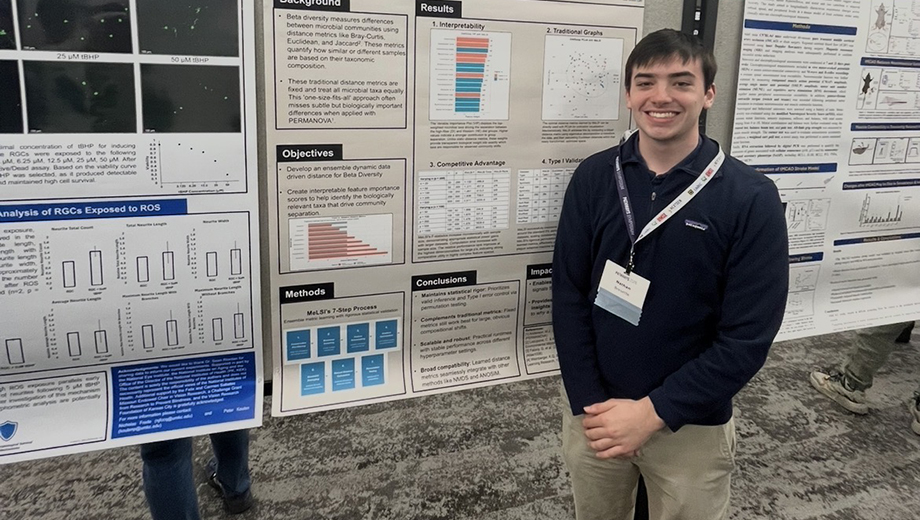
Nathan Bresette with his research poster.
Nathan Bresette presents a research poster during the UM System's NextGen Pathways Symposium in March. He is pursuing a doctorate in bioinformatics, an area supported by the School of Medicine and other campus units in the MU Institute for Data Science and Informatics. In 2025, Bresette won first place and $10,000 from EQ for his RStudio assistant.

Nathan Bresette

Informatics doctoral student focusing on bioinformatics; founder of TalkStride
Hometown: Kansas City, Missouri

Nathan Bresette's ultimate goal is to become a professor and conduct Alzheimer’s research, but he also wants to run a startup company on the side to satisfy his entrepreneurial itch.

“Entrepreneurship is a true passion of mine,” Bresette said. “While some startups fail, including some of my own, I plan to continue learning, enjoying the process and doing my best every single day.”

Bresette took first place in EQ last year with Rgent, a contextually aware AI tool that his customers downloaded to make the R programming language in RStudio easier to use. What he didn’t anticipate, however, was that RStudio would later launch a built-in AI assistant that did the same thing and made Rgent obsolete.

“Ultimately, I feel okay about it,” Bressette said. “I learned an incredible amount, made some great connections, and it allowed me to pivot to my next startup, TalkStride.”

Milestones: Bresette created his new TalkStride app to help people improve their speaking skills.

“Speaking is a muscle,” he said. “If you practice it intentionally every day, you will get better at it. The app is designed to facilitate that daily practice by gamifying it.”

Bresette also is making strides in his PhD program. He is lead author on a paper published in June by mSystems, one of the American Society of Microbiology’s peer-reviewed journals. The paper introduces a new machine-learning framework designed to improve how researchers compare and analyze microbiome communities.

“I work in Dr. Ai-Ling Lin’s lab, where we approach Alzheimer’s research from a multitude of different angles,” Bresette said. “One of the most interesting areas of our research explores how the gut microbiome is directly tied to brain health. The idea being that if we can heal the gut, we can heal the brain.”
 

How to participate in EQ

EQ is an opportunity for full-time Mizzou undergraduate and graduate students to translate their ideas and side hustles into scalable ventures. Those chosen to participate in the fall semester program have an opportunity to win seed funding from a $30,000 prize pool for their businesses and receive coaching from successful entrepreneurs.

Apply by 5 p.m. on Sept. 3.